Product Updates : August 2026
This is one of our biggest updates yet, and every feature in it shares a single goal: to catch rights and documentation issues before a release ever reaches DSPs — so releases move faster, distributors stay in control, and everyone involved gets paid and protected fairly.
Here is a step-by-step look at what is new, why we built it, and how each piece works.
1. Artist Watchlist
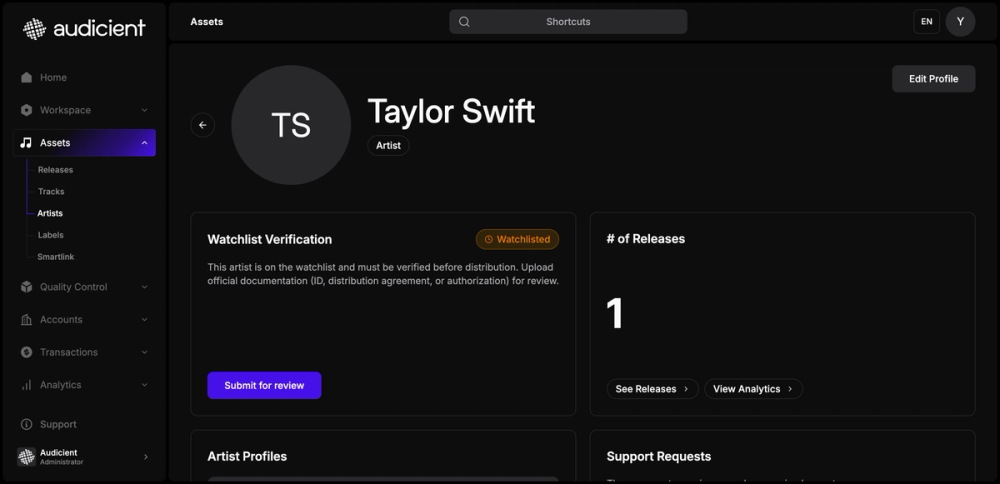
Behind every release is an artist, and behind every artist is a set of rights that need to be clean before the music goes anywhere. The Artist Watchlist makes sure those rights are verified up front, instead of being discovered too late.
The problem. Rights problems around an artist used to surface only after a release had already been delivered to DSPs. A release would go live, get flagged somewhere downstream — an impersonated profile, an artist already under watch, or a Content ID conflict — and then it had to be pulled back down. That meant takedowns, disputed earnings, wasted distribution effort, and a genuinely frustrating experience for an artist who believed their music was already out in the world.
How it works now. Now the check happens before distribution, and it turns a vague red flag into a clear, documented decision:
- When an artist is created or attached to a release, the system automatically checks them against the watchlist.
- If the artist is flagged for review, the release is held and the user is prompted to submit documentation that proves their rights or their relationship to the artist.
- The distributor reviews that documentation and either approves the artist or rejects it with a clear reason.
- Only once the artist is approved does the release continue on to distribution.
Why it matters. Rights are cleared before anything ever reaches a DSP, so there are no surprise takedowns and no disputed deliveries. Just as importantly, clean and well-documented releases are no longer held back by uncertainty — they move through approval and out to stores faster.
2. Release Notes & Attachments
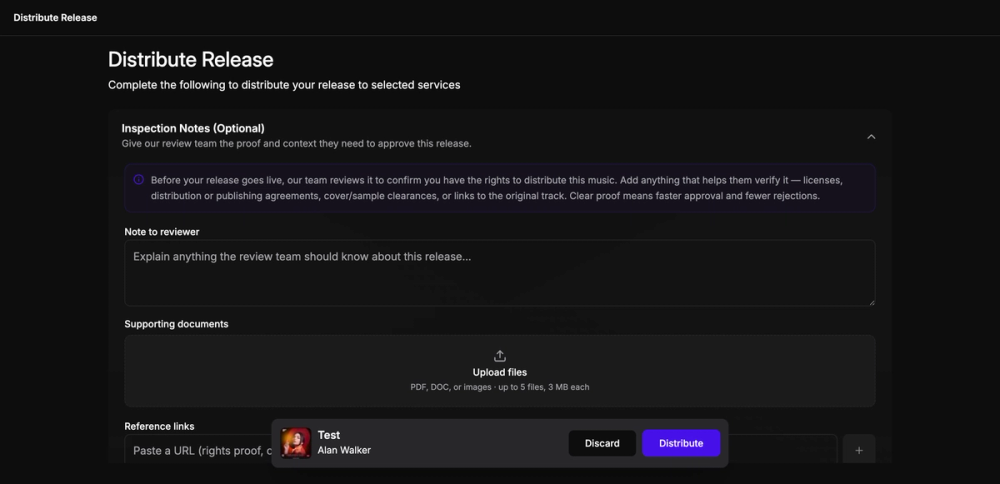
Sometimes a release is held up not because anything is wrong with the music, but because the paperwork around it is not clear. Release Notes fix that by letting all of that context travel with the release itself.
The problem. In the past, releases were often rejected simply because the supporting documentation or references were unclear, incomplete, or missing entirely. A QC reviewer would hit a question — is this cover cleared, where is the sample license, who approved this artwork — and the only options were to reject the release or start a slow back-and-forth over email to chase the missing context. That wasted the distribution team's time and pushed the release date further and further out.
How it works now. Now every release carries its own context. Directly on the release, users can:
- Add notes explaining anything a reviewer needs to know about the release.
- Attach supporting files — licenses, permissions, agreements, references — straight to the release.
- Include external links when the proof lives somewhere else.
- Preview every attachment in-app, so reviewers never have to download a file just to check it.
Why it matters. Because the answers arrive with the release, the distribution team no longer burns effort requesting documentation or rejecting releases over missing context. QC becomes faster, better informed, and far less frustrating for everyone — approvals happen on the first pass instead of the third.
3. Re-inspection
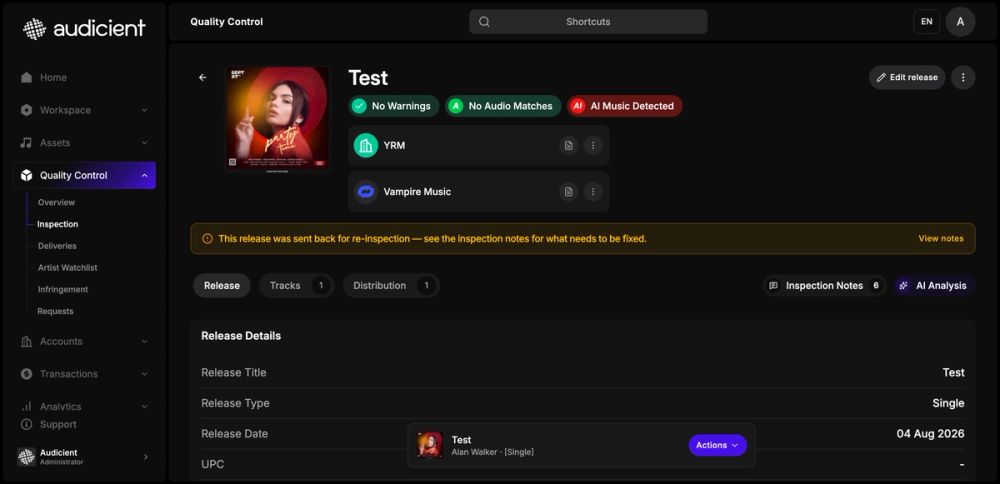
When a release runs on an Audicient deal, it goes through a second QC on our side. The real question was always what happens when that second check finds a problem. Re-inspection changes the answer.
The problem. Previously, if a distributor approved a release and it was distributed on an Audicient deal, our second QC could reject that release outright. The distributor — the person who actually owns the relationship with the artist — was left completely out of the loop. They would find out their release had been rejected only after the fact, with no chance to fix the issue, add documentation, or make the call themselves.
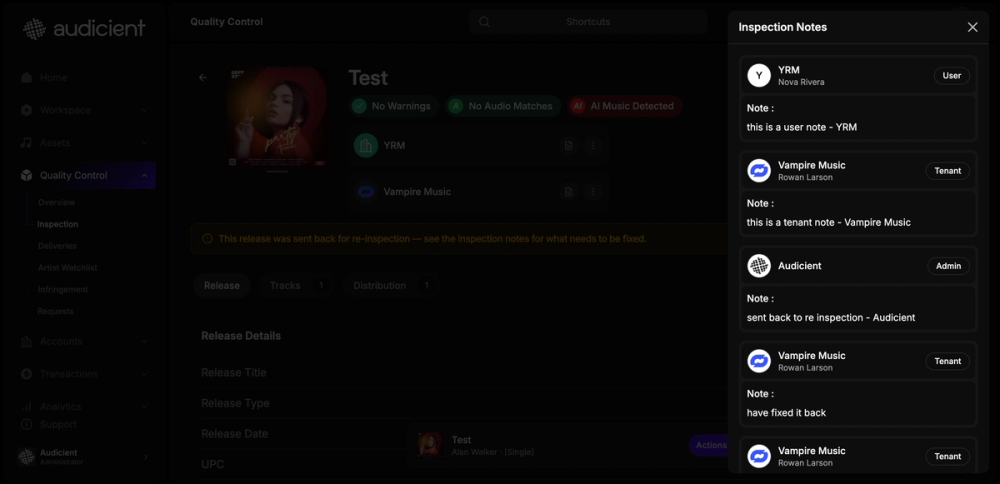
How it works now. Now Audicient never rejects these releases directly. Instead:
- When our second QC finds an issue, the release is sent back to the distributor for re-inspection rather than rejected.
- The distributor sees exactly what we flagged and why.
- They decide how to respond — reject it, request more documentation from the user, or resolve the issue and send it back through.
Why it matters. This keeps the distributor in control of their own catalogue and their own artist relationships. Nothing gets rejected behind their back, decisions stay with the people closest to the release, and issues get resolved collaboratively instead of ending in a dead-end rejection.
4. Support Requests
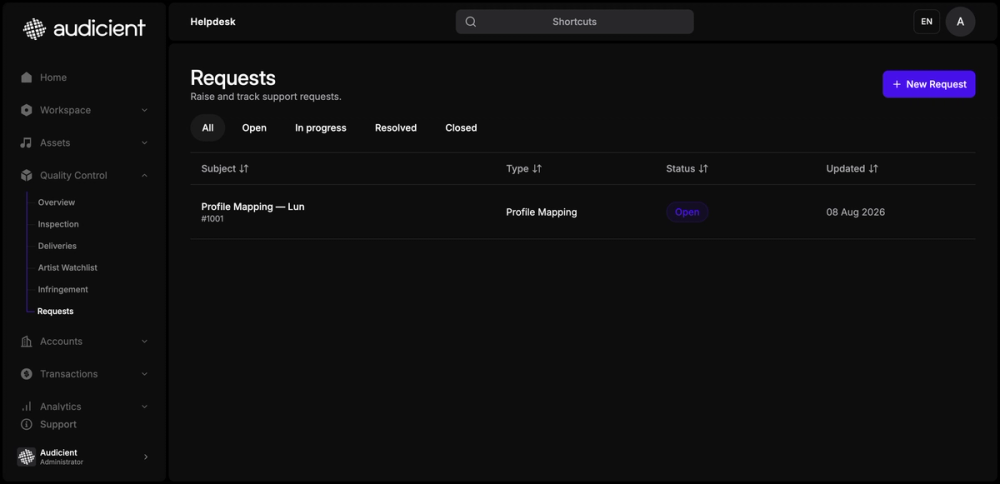
Profile mapping, Official Artist Channel requests, and similar tasks used to live in inboxes. We have moved them into the dashboard so that nothing gets lost along the way.
The problem. Before, a user who needed something like profile mapping or an OAC had to email the support team. From there it got complicated: a distributor with a direct deal would check and handle it themselves, while a distributor on an Audicient deal would forward the request on to us. It was entirely manual, spread across email threads, and almost impossible to track — requests slipped through, got duplicated, or simply went unanswered.
How it works now. Now the whole thing runs inside the dashboard:
- Users create a request directly from their dashboard — profile mapping, OAC, or anything else — with all the details in one place.
- Direct-deal distributors see and handle their own users' requests themselves.
- For releases on an Audicient deal, we automatically pick the request up and action it.
- Everyone can see the status of a request, instead of wondering where an email went.
Why it matters. This removes the manual back-and-forth and the tracking gaps in a single move. Requests are logged, routed to the right party automatically, and visible from end to end — cutting the support workload and making sure nothing falls through the cracks.
5. Infringement
Rights do not stop mattering once a release goes live. When someone infringes, there needs to be a way to act on it and to hold repeat offenders accountable. That is exactly what the Infringement module does.
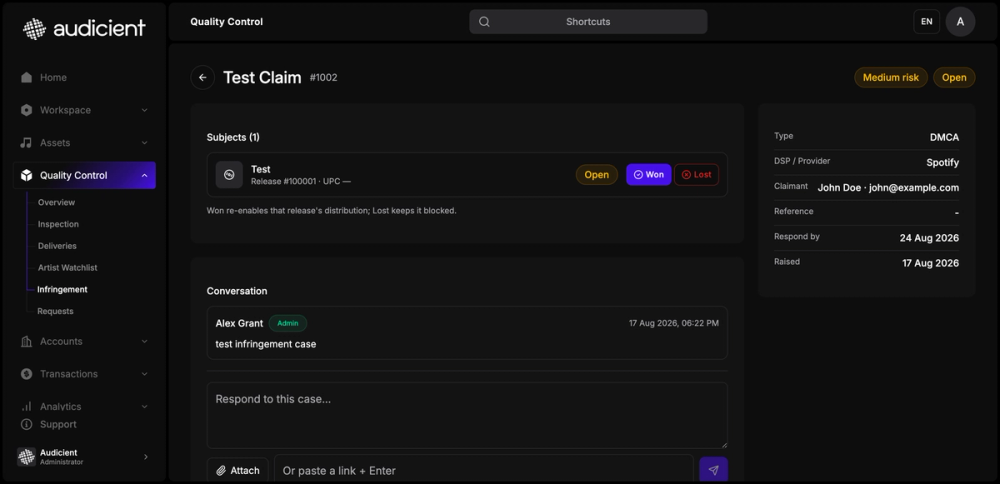
The problem. Until now, when an infringement case came up there was no real way to track it and no way to act on it. We could not record the case, could not reduce a trust score, and could not enforce any consequence. Disputes lived outside the system, so there was no accountability and no real incentive for a user to resolve things quickly.
How it works now. Infringement is now a first-class workflow in the dashboard:
- An infringement case is created and tracked inside the dashboard.
- The user is asked to submit documentation proving ownership within a set timeline.
- If they prove ownership in time, the case is resolved.
- If the deadline passes unmet, a strike is applied automatically, the user's trust score drops, and a fine is applied — with no manual intervention needed.
Why it matters. This gives every case a clear, enforceable path. Legitimate owners get a straightforward way to defend their work, while repeat or unresponsive offenders face automatic consequences that protect the platform and the artists on it.
6. Revenue Splits
Music is rarely made alone, but paying everyone involved used to be a manual, off-platform headache. Revenue Splits let collaborators share in a release's earnings directly, with the maths handled for you.
The problem. Previously, there was simply no way to invite a collaborator to share in the revenue from a release. Producers, featured artists, and co-writers had to be paid outside the system, which meant manual calculations, side agreements, and no transparency for anyone about who was owed what.
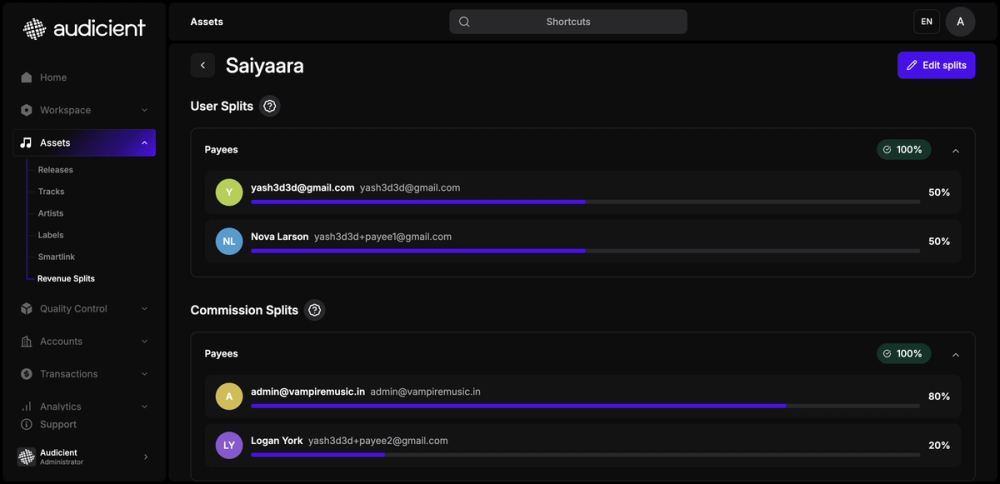
How it works now. Revenue Splits introduce sharing at two distinct levels — user splits and commission splits:
- User splits are shared from the user's own payout rate — the artist's side of the earnings.
- Commission splits are shared from the commission percentage agreed with the user — the distributor's side.
For example, on an 85:15 deal the user splits are distributed within the 85% that belongs to the user, and the commission splits are distributed within the 15% commission. Each collaborator you invite receives their agreed percentage of the right pool, automatically.
Why it matters. That means everyone — the artist's collaborators and the distributor's partners — can be paid their fair share straight from the platform, with no spreadsheets and no side deals. Invites make it easy to bring people in, and the two-level model keeps the artist's revenue and the distributor's commission cleanly separated.
7. AI QC Analysis
Quality control is essential, but checking every release by hand is slow, and deciding exactly where the bar sits is hard. AI QC Analysis speeds this up without asking you to give up control.
The problem. Deciding whether a release meets the approval criteria used to demand real time and judgment. Either someone had to manually review every single release, or teams had to agree on fuzzy metrics for what should pass. At scale that became a bottleneck — releases piled up waiting for a human to look at them, and consistency suffered as different reviewers made different calls.
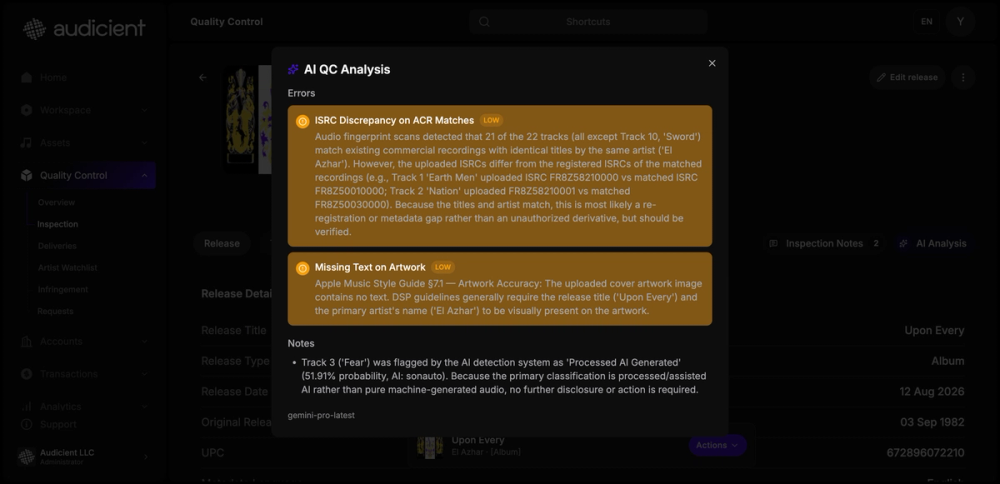
How it works now. AI QC Analysis reviews the release and gives you a clear, actionable verdict:
- The AI analyses the release — its metadata, artwork, and other signals — and produces a plain statement of whether it can be approved.
- Releases that are clearly clean can be auto-approved, so they do not wait on a human at all.
- Anything with a potential issue is held for manual QC rather than being passed or rejected automatically.
- For those, you review the AI's analysis alongside the release and make the final call yourself.
Why it matters. The result is speed where it is safe and human judgment where it is needed. Clean releases move instantly, your team's attention goes only to the releases that actually need it, and every decision is backed by a consistent, explainable analysis rather than a gut feeling.
Available today
Every one of these features is live in your dashboard today. Together they turn what used to be reactive, manual, after-the-fact work into a clear, documented flow that runs before problems ever reach your listeners. As always, we would love to hear what you think.